
Animating a Children's Book with AI: Little Kea's Big Trucks
This one is about trying to animate our first book, Little Kea's Big Trucks.
The book felt like the right place to start because it already has movement built into it — trucks, roads, diggers, fire engines, buses, a little boy watching the world go by. It always felt like something that wanted to move.
We're Josh, Sadé, and Kea — the family behind Little Kea. A small children's brand we build using AI tools, family stories, and a lot of figuring things out as we go.
We'd tried animating Little Kea before, maybe a year and a half ago. It was interesting but limited — more like product images with a little motion added on top. Useful for some things, but not really storytelling. This time felt different. Someone we follow online had posted an AI animation that stopped us mid-scroll. You know that feeling where you see something and immediately understand the tools have moved again. We wanted to test what would happen if we took the world of the book and tried to make it breathe a little.
How we did it
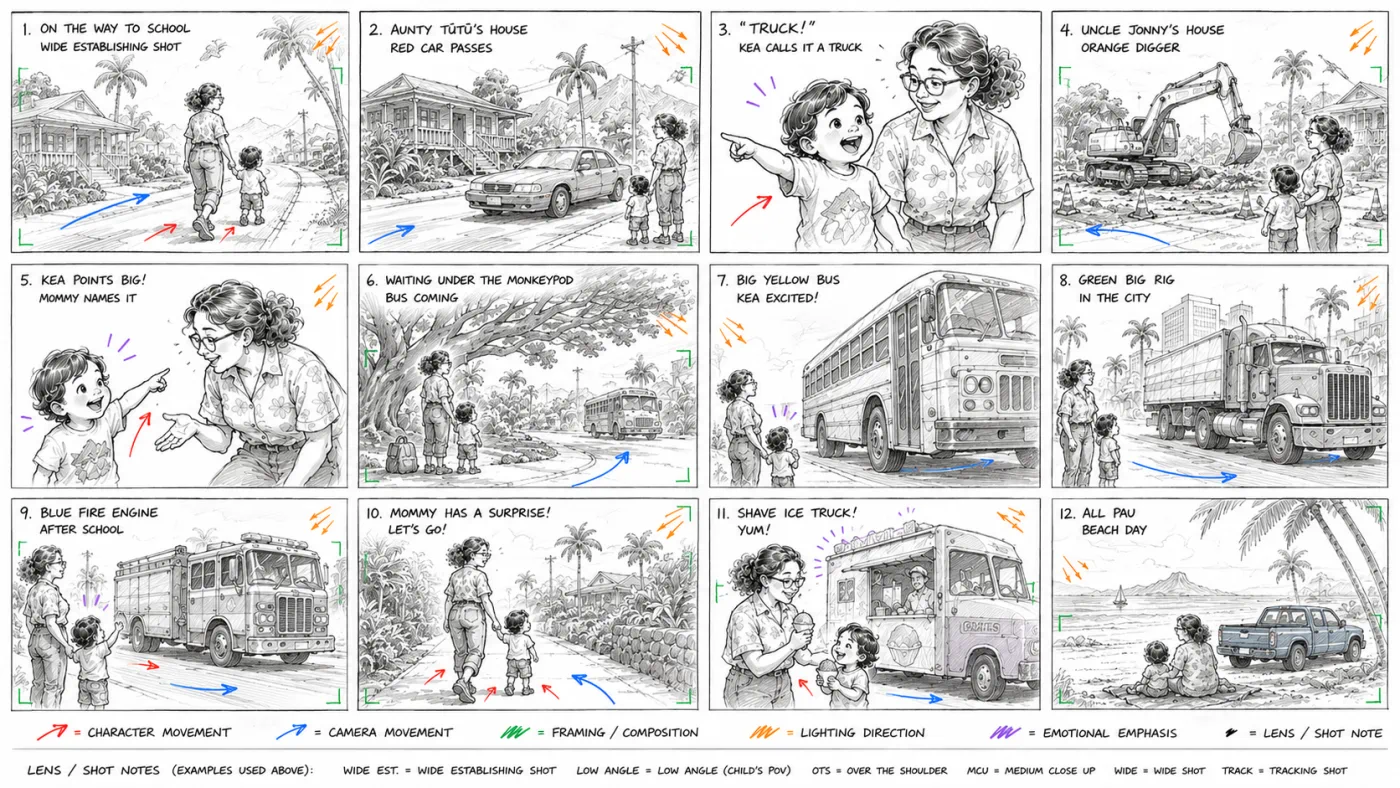
We used ChatGPT to build a storyboard and shape the prompts, then fed the storyboard, the prompts, and reference images from the book into Seedance 2.0. The first test was probably too simple — we tried to run the whole book in a single pass.
Honestly, the result was kind of incredible. The world opened up. The trucks moved. The little island road started to feel alive. There were moments where it really did feel like the book had become a small animated world.
But there were problems too. Some scenes drifted. Details changed between shots. Some moments were missing the right characters, and some of the motion felt flat — more like a moving version of a page than an actual scene.
What we learned
The biggest lesson was that you can't just throw a whole book into one prompt and hope the AI understands the story. You have to direct it — scene by scene, shot by shot. The next version needs shorter clips, better reference images, clearer character placement, and more specific action descriptions. More control over what the camera sees.
That part reminded us that making something with AI is still making something. You have to decide what matters, notice what feels off, and know when the tool gave you something genuinely beautiful versus something that only holds together for half a second before falling apart. That's the part we care about getting right.
Little Kea has always been a family experiment as much as a children's brand. We're learning how to use these tools in front of our son — not to consume more stuff, but to make things: books, characters, pictures, and now, maybe, animation. We'd rather be honest about the process than pretend it came out perfect.
The first draft is below. It's not the final version, but it's the first time we really saw Little Kea move.
If you want to see the book that started this experiment, Little Kea's Big Trucks is our first book for keiki who love diggers, fire engines, buses, pickup trucks, and big machines.